
INSIGHTS
How to find, vet, and onboard suppliers you won't regret: a playbook for procurement managers
· 13 min read
We recently polled procurement and supply chain managers across manufacturing sectors in our WhatsApp community, asking them to rank their biggest day-to-day pain points. The runaway winner, in their own words:
"Finding, screening and onboarding new suppliers I don't regret working with later."
Not price negotiation. Not logistics delays. The thing that keeps procurement managers up at night is the fear of committing to the wrong supplier — because by the time the regret shows up, you're already locked in. The tooling is paid for, the first POs are placed, production is planned around their lead times, and switching means starting the whole painful search again under even more time pressure.
This post is a practical playbook for de-risking that decision. It's built around two ideas that experienced sourcing leaders in our community swear by, but that most procurement teams still don't practice systematically:
- Never search for a supplier when you urgently need one. Maintain a ready-to-RFQ bench of pre-vetted suppliers for every part and material you source.
- Know enough about what you buy to judge who can make it. Build basic technical fluency in your parts and materials so you can evaluate supplier capability yourself, instead of deferring that judgment entirely to engineering or design.
Let's break down how to put both into practice, along with the screening and onboarding steps in between.
Why supplier selection goes wrong: you're deciding under deadline pressure
Most supplier regret isn't caused by bad judgment. It's caused by good judgment applied too late. A typical failure sequence looks like this: an incumbent supplier slips on quality or capacity, or a new product needs a part nobody currently supplies. Suddenly there's a deadline. Ask anyone who has run this gauntlet: just compiling a reliable shortlist of candidate suppliers routinely takes weeks, and onboarding a new supplier adds two to three more — often stretching to months for complex or international vendors requiring deeper compliance checks.
You don't have five weeks. So corners get cut: the audit becomes a video call, the sample run becomes a brochure review, the reference check becomes a LinkedIn glance. Six months later, the regret arrives — rejected lots, missed deliveries, surprise surcharges — and it traces directly back to decisions made in a hurry.
The fix isn't to vet faster under pressure. It's to remove the pressure.
How to find new suppliers: channels worth your time
Before you can build a bench, you need candidates flowing in — and the channel you find a supplier through tells you something about how much vetting they'll need. Roughly in order of signal quality:
Reverse marketing. Instead of searching, be findable: publish an RFI describing what you source on your website, LinkedIn, or association job boards, and let capable suppliers come to you. This works especially well for niche parts where the supplier universe is small and Google-resistant.
Peer referrals. The highest-signal channel by far. A recommendation from a non-competing procurement manager who has actually placed orders with a supplier comes pre-loaded with the one thing no directory can give you: observed behavior. Work your network deliberately — industry WhatsApp groups and communities like ours exist precisely for the "does anyone have a good supplier for X?" question. Return the favor and the channel keeps working.
Your existing supply ecosystem. Ask your current good suppliers who they buy from and who else they rate — capable suppliers tend to know their capable peers. Two underused variants: map your tier-2 suppliers (who supplies your suppliers?) for candidates you're already indirectly depending on, and ask the machine and equipment OEMs for your key processes who owns their machines in your region. An injection-molding machine maker knows every serious molder in the country — and which ones bought recently.
Trade shows and expos. Still the fastest way to assess many suppliers in one day — you can compare sample quality hands-on, gauge technical depth in five minutes of conversation, and read the intangibles (does the person at the booth understand their own process?). Go with a written gap list from your bench, not a browsing mindset. And remember that exhibitor catalogs are searchable directories that outlive the event.
Industry associations and export councils. Bodies like CII, FICCI, IIMM, and sector-specific export promotion councils (EEPC India for engineering goods, for example) publish member directories of established manufacturers — a useful pre-filter, since membership implies a minimum level of formality and longevity. Equivalent bodies exist in every manufacturing country.
B2B directories and marketplaces. TradeIndia, Alibaba, ThomasNet, Europages and their sector-specific cousins offer a breadth of listings — but treat listings as claims, not evidence. A directory profile tells you a supplier wants your business; it tells you nothing about whether they can execute. These candidates enter your funnel at the top, with the full screening process ahead of them.
Trade and customs data. Import/export records (bill-of-lading databases and similar trade-data services) can reveal who actually ships the part or material you need — including who supplies your competitors. This is verified activity rather than marketing, which makes it a surprisingly strong discovery signal for cross-border sourcing.
Whichever channels you use, log every candidate — even the ones you're not ready to engage — into the pipeline you're about to build. That's Step 1.
Step 1: Build a ready-to-RFQ pipeline for every part and material
Treat supplier discovery the way sales teams treat lead generation: as a continuous background process, not a fire drill. For every part family and material category you source, aim to maintain a live bench of two to four suppliers who are pre-vetted and RFQ-ready — meaning that if your primary supplier failed tomorrow, you could send a complete RFQ to a qualified alternative the same day.
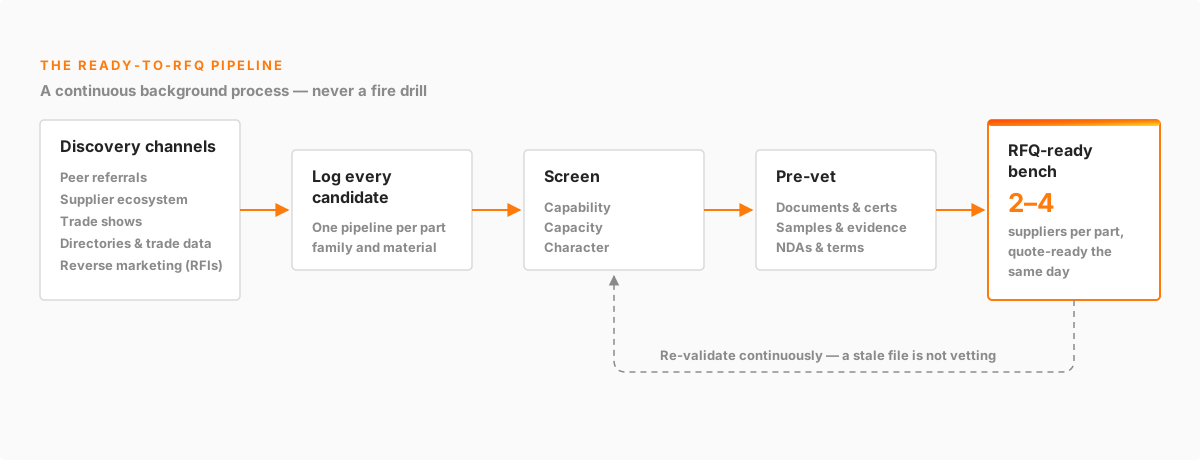
What "RFQ-ready" should mean in practice:
- Verified basics on file: business registration, certifications (ISO 9001, IATF 16949, or whatever your sector demands), financial health indicators, and export/import credentials if cross-border.
- Capability confirmed, not claimed: you've seen evidence — machine lists, process capability data, sample parts, or an audit (on-site or virtual) — that they can actually make your part at your tolerances and volumes.
- Commercial groundwork done: NDAs signed, standard terms reviewed, and at least indicative pricing benchmarked so you know their ballpark before you need them.
- A named contact who knows you: a relationship, even a thin one, beats a cold inquiry when you need a quote in 48 hours.
Practically, this means dedicating a small, protected slice of your week — even two or three hours — to pipeline work: working the discovery channels above against a written list of gaps in your bench, sending exploratory RFIs, and periodically re-validating benched suppliers so the file doesn't go stale (a certificate that expired last year is not vetting; it's decoration).
The payoff compounds. A live bench doesn't just rescue you in emergencies — it gives you real negotiating leverage with incumbents, live market price intelligence, and a much larger sample of suppliers observed over time, which is the single best training data for your own judgment.
If the maintenance burden is what's stopped you from building a bench like this, that's precisely the gap new agentic sourcing tools are closing — Chaiyn, for instance, finds vetted suppliers instantly and onboards them in days instead of weeks, so the bench stays live without consuming your calendar.
Step 2: Develop technical fluency in what you buy
Here's an uncomfortable pattern many procurement managers will recognize: when a supplier's capability is in question, the evaluation gets handed to engineering or design — and procurement's role shrinks to comparing quotes. The problem is that engineering evaluates suppliers through an engineering lens (can they hit the spec?) while nobody is evaluating them through the sourcing lens (can they hit the spec repeatedly, at this volume, at this price, with this lead time, while staying solvent?).
You don't need an engineering degree to close that gap. For each major part or material category you own, aim to understand:
- The making of it: the core manufacturing processes involved (casting vs. forging vs. machining; injection molding vs. thermoforming), and which process steps are hardest to get right.
- The failure modes: what typically goes wrong with this part in the field or at incoming inspection, and which supplier capabilities prevent those failures.
- The cost drivers: roughly what share of the part's cost is raw material vs. processing vs. tooling amortization — so you can tell a sharp quote from a loss-leader that will resurface as a price increase or quality shortcut.
- The right questions: enough vocabulary to ask a supplier about their process controls, equipment, and quality data and understand whether the answers are substantive or smoke.
Sources for this fluency are closer than you think: sit in on your own incoming-inspection reviews, ask your engineers for a 30-minute walkthrough of your top five parts, walk supplier shop floors with genuine curiosity, and read the test reports you're already receiving. Procurement managers who do this consistently report a second-order benefit: suppliers behave differently when they realize the buyer understands the product. Vague answers and padded quotes get harder to sustain.
Technical fluency doesn't replace engineering's sign-off — it means procurement arrives at that conversation with an independent view, and catches the capability gaps that a spec-focused review misses.
Step 3: Screen suppliers on capability, capacity, and character
With a pipeline feeding you candidates and enough fluency to judge them, screening becomes a structured comparison rather than a leap of faith. A useful mental model used widely in procurement training (including CIPS coursework) is Ray Carter's 10 Cs of supplier evaluation — competency, capacity, commitment, control, cash, cost, consistency, culture, clean (sustainability/ethics), and communication. You don't need all ten formalized; you do need to cover three clusters:
Capability — can they make it? Evidence over claims: sample or pilot runs evaluated against your drawings, process capability data, equipment lists matched to your part's requirements, and relevant certifications checked for scope and expiry — a certificate audited against a different product line 18 months ago tells you little about today.
Capacity — can they make it at your volume, alongside everyone else's? Ask what share of their capacity your business would represent (too small and you're deprioritized; too large and you're a concentration risk for both sides), who their other major customers are, and how they handle demand spikes.
Character — will they behave well when things go wrong? This is the cluster most screening skips and most regret traces back to. Check references from customers of similar size to you, not their flagship accounts. Probe how they communicated during their last quality escape or delivery crisis — every supplier has had one; the honest ones will tell you about it. Watch responsiveness during the RFQ itself: a supplier who is slow and vague while courting you will not improve after the PO.
Red flags worth treating as disqualifying rather than negotiable: reluctance to allow a site visit or virtual factory tour, quotes dramatically below the pack without a credible explanation, certifications they can't produce documents for, and evasiveness about financial health or customer references.
Step 4: Onboard deliberately — the contract is the beginning, not the end
Regret is often manufactured in the gap between "supplier selected" and "supplier performing." A deliberate onboarding closes that gap:
- Document everything up front: specifications, quality requirements, inspection criteria, packaging and labeling standards, delivery terms, and escalation contacts — agreed in writing before the first production PO.
- Start with a trial order or pilot lot, inspected at heightened scrutiny, before committing planned volumes. Structure your first three to six months as a probation period with explicit exit criteria.
- Run parallel supply where the part is critical: keep the incumbent (or a bench supplier) active on partial volume until the new supplier has demonstrated consistency across multiple lots.
- Set the performance baseline on day one: agree the scorecard metrics — on-time delivery, incoming quality (PPM or lot acceptance rate), responsiveness — and the review cadence before the relationship starts, when it's a neutral process question rather than an accusation.
Step 5: Keep score, and feed the results back into your pipeline
A simple quarterly scorecard per supplier — quality, delivery, cost competitiveness, communication — does two jobs. It catches drift early, while it's still a conversation rather than a crisis. And it continuously re-ranks your bench: today's backup that outperforms on a trial order is tomorrow's primary, and today's primary that slips knows there's a vetted alternative one RFQ away. That quiet fact does more for supplier performance than any penalty clause.
The playbook in one paragraph
Don't search under pressure — maintain a ready-to-RFQ bench for every part you source, refreshed continuously. Learn enough about your parts to judge capability yourself, so procurement evaluates suppliers holistically instead of outsourcing that judgment to engineering. Screen on capability, capacity, and character with evidence rather than claims. Onboard through pilots and probation, not straight to full volume. And keep score, so your bench stays live and your incumbents stay honest. Supplier regret isn't eliminated by finding perfect suppliers — it's eliminated by never being forced to bet everything on an unvetted one.
FAQ
What is the best way to find new suppliers?
Peer referrals from non-competing procurement professionals are the highest-quality channel, because they come with observed performance rather than marketing claims. Beyond referrals, the most productive channels are your existing suppliers' networks, trade shows, industry association directories, B2B marketplaces (treated as leads to vet, not vetted options), customs/trade data, and publishing RFIs so suppliers find you.
How many backup suppliers should I maintain per part or material?
Two to four RFQ-ready alternatives per critical part family is a practical target. Fewer than two gives you no real leverage or fallback; more than four is usually not maintainable with a lean procurement team.
How long does supplier vetting and onboarding take?
Compiling and screening candidates commonly takes several weeks, and onboarding typically adds two to three more — sometimes months for complex or international suppliers. This is exactly why vetting should happen continuously in the background rather than at the moment of need. Modern agentic sourcing platforms like Chaiyn compress this cycle dramatically, surfacing pre-vetted suppliers instantly and cutting onboarding to days.
What's the most reliable predictor of a bad supplier relationship?
Behavior during the courtship. A supplier who is slow to quote, vague on technical questions, or resistant to site visits while trying to win your business will be worse once they have it.
Should procurement or engineering own supplier capability evaluation?
Both, with different lenses. Engineering confirms the supplier can meet the specification; procurement should independently assess whether they can meet it repeatedly, at volume, at a sustainable cost, with acceptable risk. Procurement teams that build basic technical fluency in their categories make materially better sourcing decisions.
Further reading
- Ray Carter's 10 Cs of Supplier Evaluation — a supplier assessment model widely taught in CIPS (Chartered Institute of Procurement & Supply) curricula
- Deloitte's annual Global Chief Procurement Officer Survey and ISM (Institute for Supply Management) publications — credible, vendor-neutral sources on procurement benchmarks and supplier risk trends